
AI in healthcare,
from strategy to safe deployment.
Most AI playbooks are gated PDFs with 150 logos. This one is a working tool: eight domain deep dives, 29 concrete plays, a readiness assessment that writes your roadmap, an ROI modeler that survives a CFO, and a governance toolkit aligned to NIST AI RMF, HIPAA, FDA, ONC HTI‑1 and the Joint Commission–CHAI guidance.
Every corner of the AI conversation, one operating model.
Hover or tap a domain. Each one opens into a deep dive with use cases graded proven / emerging / frontier, KPIs, pitfalls, mapped vendors and plays you can drop straight onto a roadmap.
Not a document. Instruments.
Every widget below is a live miniature of the real thing inside the app. Try them.
Readiness assessment
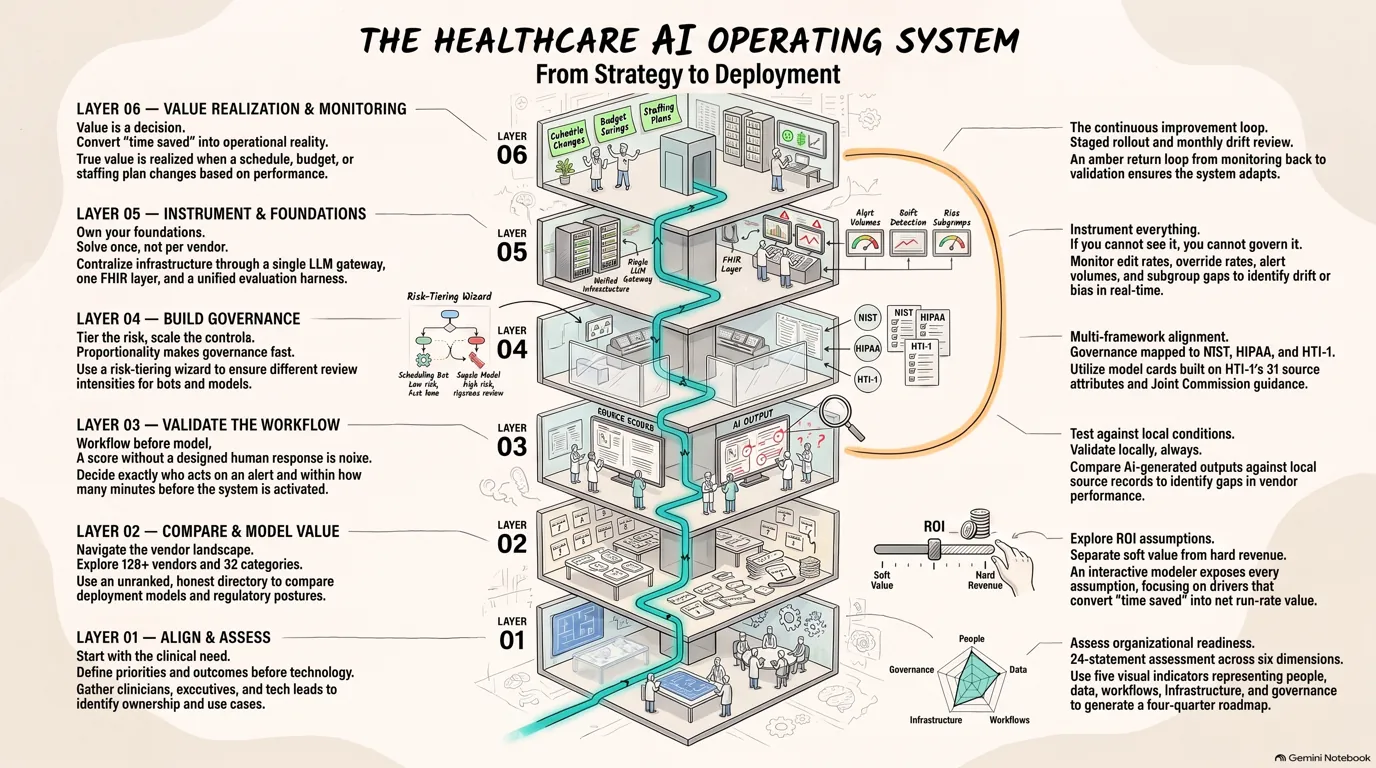
24 statements across six dimensions. Live radar, maturity level, focus advice — and a button that turns the result into a four‑quarter roadmap.
Start assessing →ROI modeler
Three value models with every assumption exposed. Soft value (time) is kept apart from hard value (revenue), with sensitivity on the driver that matters.
Model the value →Roadmap builder
Drag plays into four quarters. Prerequisite checks flag sequencing mistakes, effort load is scored per quarter, and it exports to Markdown or JSON.
Sequence the work →Governance toolkit
A lifecycle checklist mapped to five frameworks, a risk‑tiering wizard that right‑sizes controls, and a model card generator built on HTI‑1's 31 source attributes.
Govern with confidence →Tool landscape
128 vendors, EHRs, clouds and open‑source projects across 32 categories, filterable and comparable three at a time. Unranked, unendorsed, honest.
Explore the market →Search everything
One command palette across pages, domains, plays, vendors, use cases and glossary terms. Dark and light themes, print styles, and full export/import of your data.
Open and press ⌘K →Six principles that survive contact with a hospital.
- 01
Workflow before model
A score without a designed human response is noise. Decide who acts, on what, within what time, before anything is switched on.
- 02
Validate locally, always
Vendor performance is a hypothesis about your population. Published external validations have repeatedly found large gaps.
- 03
Tier the risk, scale the controls
A scheduling bot and a sepsis model should not go through the same process. Proportionality is what makes governance fast.
- 04
Instrument everything
Edit rates, override rates, alert volumes, subgroup gaps. If you cannot see it, you cannot govern it.
- 05
Own your foundations
One LLM gateway, one FHIR layer, one evaluation harness. Solve them once, not per vendor.
- 06
Value is a decision
Time saved becomes value only when a schedule, budget or staffing plan changes. Write that down before the pilot.
What's real. What isn't.
The single biggest failure mode in health‑AI content is confident claims nobody checked. So the playbook says out loud what it is and is not.
Verified against primary sources
- FDA's AI‑enabled device list: 1,614 entries as of September 2026, ~76% radiology, ~96% via 510(k).
- ONC HTI‑1: 31 source attributes for predictive decision support; DSI criterion in force with enforcement discretion through Feb 2026.
- Joint Commission + CHAI Responsible Use of AI in Healthcare guidance, September 2025, seven elements.
- Olive AI shut down in October 2023 — it is in the landscape as a vendor‑viability lesson, not a recommendation.
- Microsoft Dragon Copilot is the successor to Nuance DAX Copilot.
Labelled as provisional
- The readiness assessment is a structured self‑assessment — not a validated instrument, not a benchmark.
- The ROI modeler computes from your inputs; the defaults are placeholders so the page renders.
- The tool landscape is illustrative and unranked. No entry has been evaluated; inclusion is not endorsement.
- “SaMD category” describes a product category's typical regulatory posture, never a specific clearance.
- Nothing here is legal, regulatory or clinical advice.

Before you open it.
Where does my data go?
Nowhere. Assessment answers, roadmap, checklist progress, model cards and ROI inputs are stored in your browser's localStorage. There is no backend, no analytics, no network calls. You can export everything as JSON and import it on another machine.
Who is it for?
CMIOs, CNIOs, chief AI/digital officers, informatics leads, revenue‑cycle and access executives, governance committees, and anyone who has to decide whether to turn a model on. It is written for U.S. provider organizations; adapt the regulatory content for other jurisdictions.
Do I need to install anything?
No. It is a static site with zero dependencies and no build step. Open app.html directly or serve the folder with any static host.
How is content structured?
Everything is plain data: domains, use cases, plays, tools, assessment statements, checklist items and glossary terms live in js/data/. Add a play and it appears in the domain page, roadmap library, search palette and roadmap generator automatically.
Why no vendor rankings?
Because ranking without evaluation is marketing. The landscape shows who does what, their deployment model and regulatory posture, and gives you a comparison table and diligence prompts. The judgement stays with you.
Is there a film, podcast or slide deck?
Yes — the media library has a film (YouTube), a 22‑minute streaming‑only podcast, a 30‑slide PDF deck and two PNG infographics. The podcast is playback only; no download is offered.
Open it. Answer 24 questions. Leave with a roadmap.
About eight minutes from a blank page to a sequenced, prerequisite‑checked four‑quarter plan you can export to your steering committee.